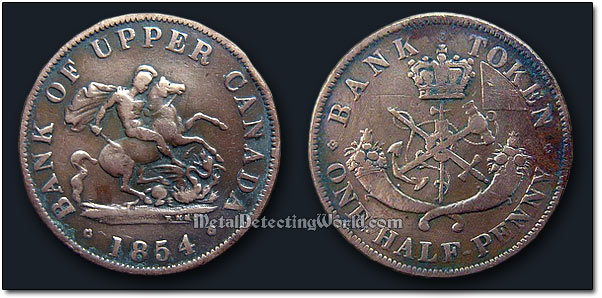
Canada Bank Tokens
Under
the British rule, Pre-Confederation tokens, Bouquet Sous, Habitant Sous, half
penny and penny tokens, served as coins until 1867 when Confederation formed the
Dominion of Canada which started issuing decimal coins in 1870. About the beginning
of the 19th century, the balance of trade and valuation of the coins of the various
minting countries (principal among them the Spanish milled dollar) caused a continuing
export of coins from Canada.
This resulted in a lack of coinage for making change and small transactions. To counteract this, extensive quantities of low-denomination tokens were imported from England by merchants who made money through token issuance both by encouraging trade at their establishment and by profit on the cost of the tokens themselves.
In 1837, Hard Times brough discontent. The French had never been happy with English rule in Lower Canada, the Lawrentian plain to about Lake Erie. Upper Canada, the lands along Great Lakes, was 80% American or mostly non-English. A small number of powerful families controlled Canada, much to the dislike of the hardy pioneering types. Rebellions broke out in both Upper and Lower Canada. They were crushed.
The government authorized 4 banks, the Bank of Montreal, the Quebec Bank, the City Bank and La Banque du Peuple, to issue copper pennies and halfpennies with the arms of Montréal on one side and a standing habitant on the other. These coins arrived in Canada just as the Rebellion of 1837 began and were issued in 1838.

When Upper and Lower Canada were reunited into the Province of Canada in 1841, the Bank of Montreal was allowed to coin copper; pennies and halfpennies appeared in 1842. Halfpennies were issued again in 1844. After 1849 the Bank Of Upper Canada received the right to coin copper and large issues of pennies and halfpennies appeared in 1850, 1852, 1854 and 1857. The Quebec Bank was allowed to issue pennies and halfpennies in 1852.
Under
the Province of Canada only bank tokens were issued and no merchant or private
tokens were allowed. No Province of Canada tokens were issued after 1857, as the
British government introduced 1, 5, 10 and 20 cent pieces in 1858 quickly followed
by issuances from provinces of Nova Scotia and New Brunswick (1861), Newfoundland
(1865), and Prince Edward Island (1871).
The Pre-Confederation tokens were struck at the folloing mints: The Royal Mint, Boulton & Watt, Ralph Heaton & Co., Thomas Halliday, William Mossop, Wright & Bale, Belleville Mint (New Jersey), Jean Marie Arnault, and various Blacksmith Mints.
(Source: The Charlton Standard Catalogue of Canadian Colonial Tokens)
Shown in the Photogallery below are the images of some representatives of various types of Canada Bank tokens and US tokens such as Hard Times Tokens, Patriotic Civil War Tokens, Tokens of the Gay Nineties, and other types that I found around cellar holes, foundations, stone walls, and in the fields while relic hunting in Upstate NY.
Photogallery of US & Foreign Tokens
Back To US Tokens Page | MetalDetectingWorld Home